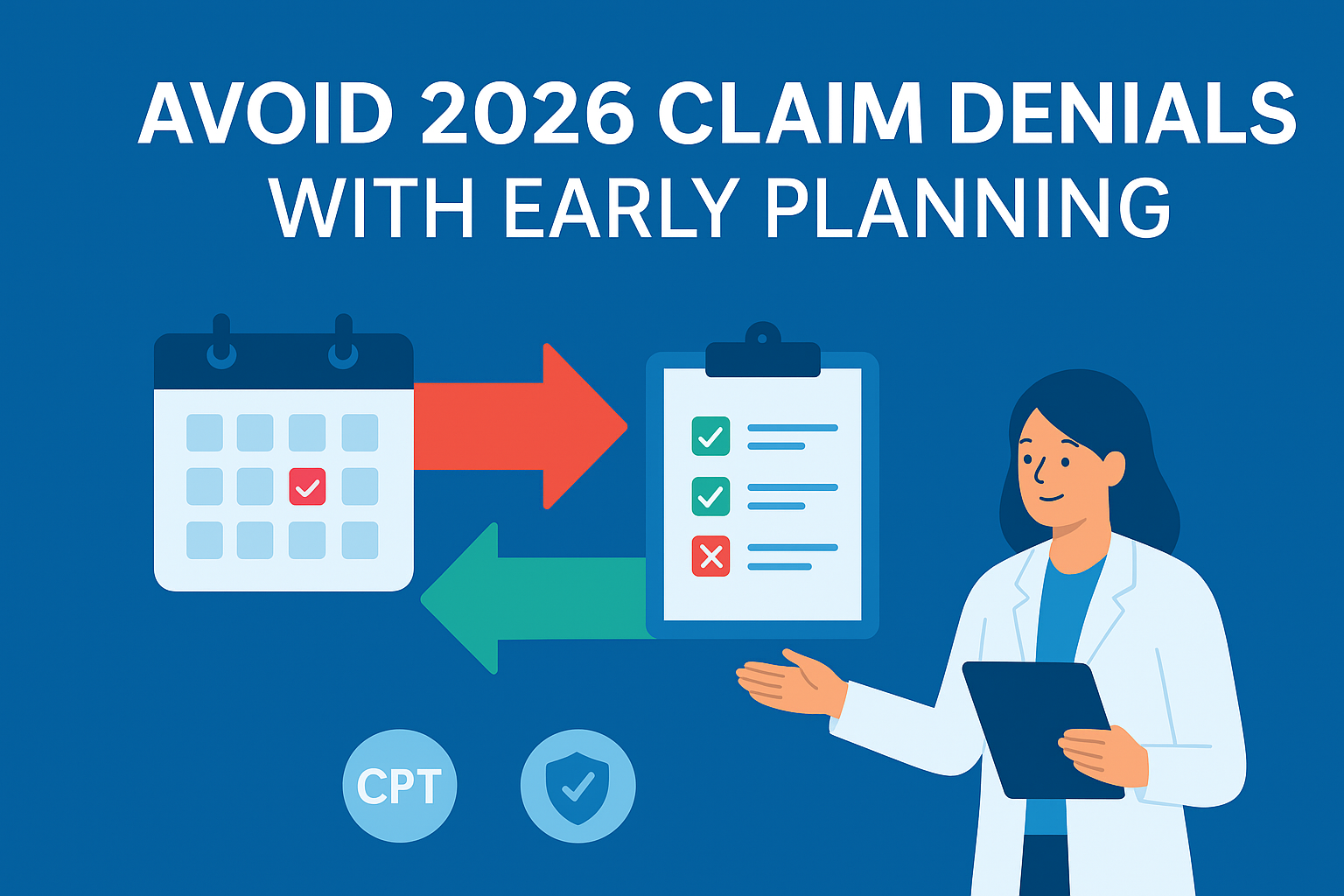
Claim denials are one of the fastest ways to stall a practice’s cash flow. In 2026, a mix of code changes, payer policy updates, prior-authorization reforms, and growing automation will create both opportunities and new points of friction – which means planning now will pay off quickly. This guide explains the high-impact denial drivers you’re likely to face next year and gives clear, practical steps your practice can take this month to prevent denials before they happen.
We’ve pulled guidance from CMS, the AMA, and leading industry analysts so you can act with confidence.
Why 2026 is a “watch and act” year for denials?
Several converging changes will alter how payers review claims in 2026:
Major CPT code updates (Category I additions, deletions, and revisions) go live on Jan 1, 2026 — affecting how encounters, telehealth, remote monitoring, and AI-assisted services are billed. CMS policy changes in the 2026 Physician Fee Schedule adjust payment rules and claim-level logic for Medicare Part B. Practices that don’t map new rules to their billing logic risk mis-billed claims. Prior-authorization reform and interoperability rules are driving standardized electronic prior-auth paths meaning payers will both automate and tighten certain prepayment checks. Federal and private payer efforts to standardize dispute/IDR and surprise-billing workflows mean providers must be more exact with patient notices and balance-billing safeguards.
Put simply: payers will expect cleaner documentation, new codes used correctly, and more prior checks before payment. Practices that act early will avoid the general spike in denials others will see.
Top denial drivers for 2026 — and how to stop them now
- Wrong, missing, or obsolete CPT/HCPCS codes
New CPT codes take effect Jan 1; using retired or incorrect codes will trigger rejections or denials. Update your EHR coding tables and claim scrubbing rules immediately. Run a report of your top 50 billed codes and validate whether each has a 2026 replacement or modifier change.
Action items
Install the CPT 2026 update in your practice management/EHR system now.
Host a 60-minute coder training on high-impact code changes (telehealth, RPM, AI codes).
- Telehealth and modality documentation gaps
Payers are scrutinizing telehealth — especially audio-only vs. video, consent, and place-of-service. Incomplete documentation often translates to a denial. Standardize your telehealth note templates to include modality, patient consent, duration, and clinical justification.
Action items
Update telehealth templates and add mandatory fields in the EHR.
Train providers on required telehealth documentation and the correct modifier usage.
- Prior authorization misses or incorrect submission
New CMS interoperability and prior-authorization rules are pushing payers toward electronic workflows — but until they’re fully adopted, manual errors still cause denials. Centralize prior-auth intake and use payer-specific checklists. Consider a clearinghouse or RCM partner that supports 278/278X electronic messaging.
Action items
Audit last 6 months of services requiring authorization; identify where denials occurred.
Create a one-page prior-auth checklist per payer and embed it into scheduling and pre-visit workflows.
- Eligibility and benefits surprises (real-time verification)
Patients with inactive coverage or missing authorizations are a top source of denials and patient billing headaches. Implement real-time eligibility checks at registration and re-verify on day of service for high-risk payers.
Action items
Turn on real-time eligibility in your PM/EHR or use a clearinghouse/verification tool.
Train front-desk staff to document eligibility snapshots (system plus time stamped).
- Poor documentation of medical necessity (and AI/digital services)
New digital health and AI-assisted codes require clear documentation of clinical necessity and clinician oversight. Payers will deny or downcode if notes are thin. Update note templates to capture device or algorithm use, frequency of monitoring, and clinician interpretation.
How technology and partners can help (don’t go it alone)
Two levers reduce denials faster than anything else: automation and specialized expertise.
Automation — claim scrubbing tools, real-time eligibility, EDI/278 prior-auth workflows, and AI-driven denial prediction reduce the human error factor.
Specialized partners — experienced RCM teams know payer nuances, test rules in sandboxes, and maintain up-to-date code mappings. They also provide structured denial management and staff training.
If you don’t have the internal bandwidth, engaging a white-label RCM or outsourcing specific functions (eligibility, prior auth, denial appeals) is a practical way to reduce denials quickly.
Realistic expectations – and measuring progress
Cutting denials is not a one-day sprint. Set realistic KPIs:
– Clean claim rate (first-pass acceptance) — aim for 95%+ for routine outpatient services.
– Denial rate — track payer and denial reason; reduce high-frequency issues by 50% in 90 days.
– Days in A/R — watch for declines as denials fall.
– Appeal success rate — measure reversals on denials and use those patterns to fix upstream causes.
Track these weekly and review monthly with the practice team and your RCM partner.
Bottom line: act now, avoid winter denials
2026 won’t be dominated by a single change — it will be dozens of small rule edits and code updates that, collectively, create denials for unprepared practices. The simplest path to stability is to treat December as a project month: update codes, harden telehealth and prior-auth workflows, enable real-time eligibility, and lock in a denial triage process.
If you’d like a practical, no-cost readiness check, AllegianceRCM will review your top 25 CPTs, simulate scrubbing against 2026 rules, and deliver a prioritized 30-day action plan for avoiding the most common denials. Reply to schedule a 15-minute assessment.
Sources & further reading
AMA — CPT® 2026 code set release.
American Medical Association
CMS — CY 2026 Medicare Physician Fee Schedule (final rule).
Centers for Medicare & Medicaid Services
CMS — Interoperability and Prior Authorization Final Rule (CMS-0057-F).
Centers for Medicare & Medicaid Services
CMS — No Surprises Act resources & IDR reports.
Centers for Medicare & Medicaid Services