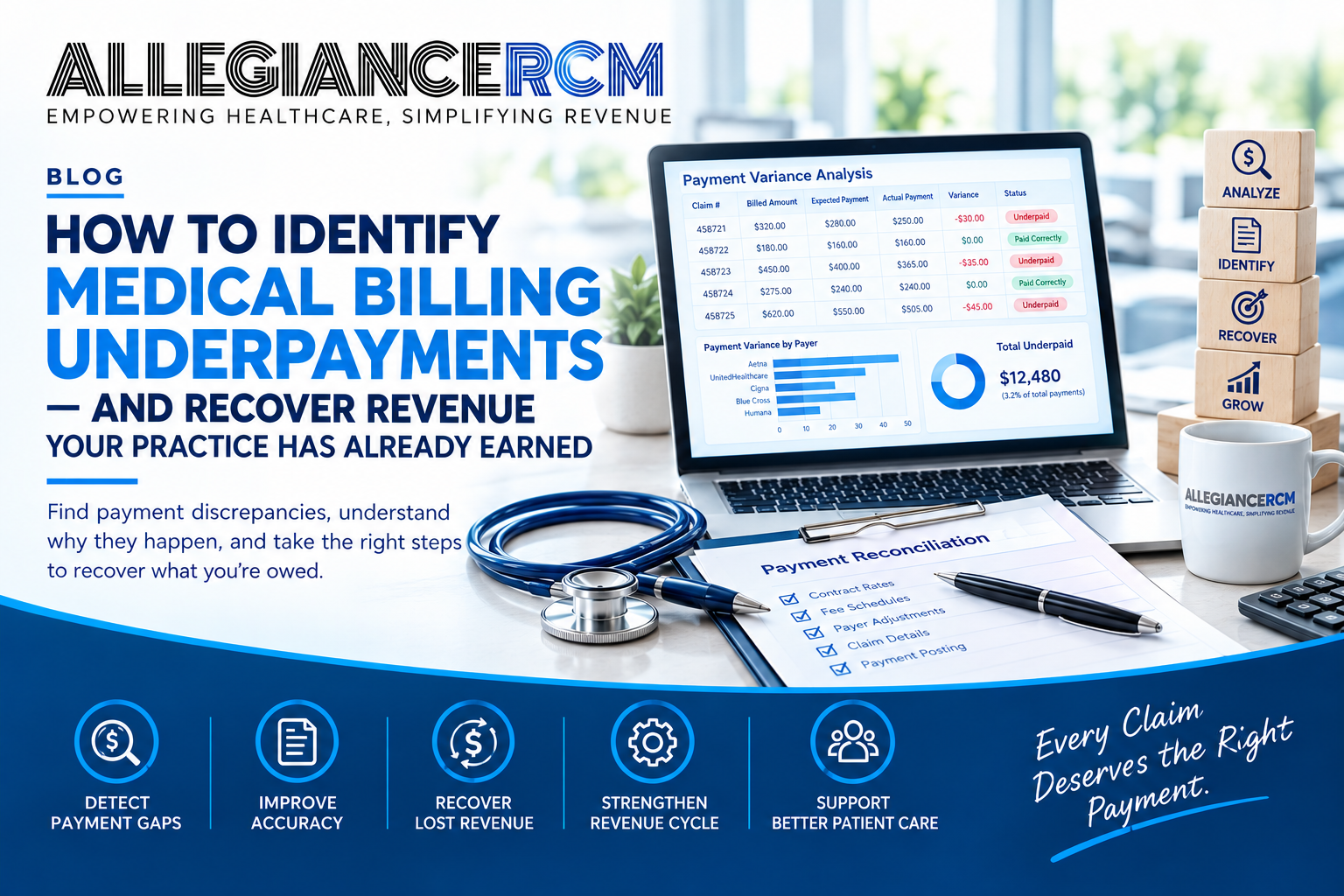
A claim can be marked “paid” and still be a problem. That may sound strange to a busy physician or practice manager. After all, if the insurance company processed the claim and sent a payment, the billing team has done its job – right? Not necessarily.
Imagine a practice submits a claim expecting $150 based on its payer contract. The insurance company processes the claim and pays $112. The payment posts automatically, the balance is adjusted, and the account disappears from the work queue. Nothing looks obviously wrong. But that $38 difference may represent revenue the practice was entitled to receive. Now multiply that by 20 claims a week, 100 claims a month, or thousands of claims a year.
This is where medical billing underpayments become one of the quieter forms of revenue leakage in a physician practice. Unlike a denial, an underpaid claim does not necessarily produce an alert telling someone to investigate it. The claim may simply look finished. For independent practices operating in an increasingly complex reimbursement environment, identifying these payment discrepancies can be just as important as reducing denials.
What Is a Medical Billing Underpayment?
A medical billing underpayment occurs when an insurance payer reimburses a claim for less than the amount the practice should have received based on the applicable contract, fee schedule, coding, and other payment rules. The important word is “should”. The amount billed is not necessarily the amount a practice expects to collect. Insurance contracts establish allowed amounts, reimbursement methodologies, contractual adjustments, and other terms. An underpayment occurs when the actual reimbursement does not match the payment the practice is contractually or otherwise appropriately entitled to receive.
The American Medical Association specifically advises physician practices to monitor whether health insurers are properly adjudicating claims and to address improper payment adjustments. Its resources identify underpayments, downcoding, inappropriate PPO discounts, bundling issues, and other payment discrepancies as situations that may require review and appeal. That means a practice should not stop its revenue cycle process simply because the payer issued a payment.
Why Underpayments Are So Easy to Miss
Denials are visible. A claim comes back denied, and someone has to do something about it. It enters a denial queue, appears on an aging report, or generates a rejection message. Underpayments can be much quieter. The payer sends an electronic remittance advice (ERA), the payment is posted, contractual adjustments are applied, and the account may be considered closed. Unless somebody compares the actual payment with the expected reimbursement, the discrepancy can disappear into the normal workflow.
The AMA notes that electronic remittance information can help practices identify payment errors and compare allowed amounts with applicable fee schedules. This is why payment variance analysis deserves a place alongside denial management, A/R management, and clean-claim monitoring in a strong healthcare revenue cycle management strategy. A practice does not only need to know, “Did we get paid?” It needs to know, “Did we get paid correctly?”
The Most Common Causes of Medical Billing Underpayments
Underpayments can happen for several reasons, and not every difference automatically means the payer made an error. Sometimes the issue begins with coding. A payer may downcode a service to a lower level of reimbursement. The AMA identifies E/M downcoding as one type of payment issue that physician practices may need to investigate, particularly when the medical documentation supports the higher level of service billed.
Bundling can create another problem. Multiple services performed during the same encounter may be combined into a single payment when the payer’s rules allow it. In some circumstances, however, separate services may appropriately qualify for separate reimbursement. Contract application is another major area.
A payer may apply the wrong fee schedule, an incorrect contractual adjustment, or a discount that does not apply to the practice. The AMA specifically identifies inappropriate PPO discounts and contractual payment issues among the situations practices should review. There can also be payer-specific processing rules, modifier issues, authorization-related payment differences, or changes in reimbursement terms. The key is not to assume every variance is an underpayment. The key is to determine whether the payment matches the rules that actually apply to that claim.
Start With Expected Versus Actual Payment
One of the simplest ways to begin identifying underpayments is to establish an expected reimbursement for each claim and compare it with the actual payment. For example, suppose a practice has an expected allowed amount of $200 for a particular service. The payer processes the claim and pays $165.
The initial payment variance is: Expected payment − Actual payment = Payment variance
In this example: $200 − $165 = $35
The next question is more important: Why is there a $35 difference?
Perhaps the patient was responsible for $35 and the payer correctly paid $165. Perhaps the contractual adjustment was applied correctly. Or perhaps the payer used the wrong fee schedule. Without reviewing the explanation of benefits or ERA and comparing it against the applicable reimbursement terms, the practice cannot know. This is why payment variance analysis should focus on the reason behind the difference, not simply the size of the difference.
Your ERA Can Tell a Story
The ERA is more than a payment posting document. It contains information that can help billing teams understand how the payer adjudicated the claim, including payment amounts, adjustments, reason codes, and other details relevant to the final reimbursement. A good payment posting process should therefore do more than enter the deposit into the practice management system.
It should help answer questions such as:
- Was the expected reimbursement received?
- Was the correct contractual adjustment applied?
- Was the claim downcoded?
- Was a procedure bundled?
- Was a modifier ignored?
- Was an unexpected discount applied?
- Was the patient responsibility calculated correctly?
- Was there another payer involved?
These questions turn payment posting from a clerical activity into a revenue protection function. The AMA recommends monitoring payer payments and ensuring that payments and adjustments are correctly applied before patient statements are generated.
Look for Patterns, Not Just Individual Claims
Finding one underpayment is useful. Finding a pattern is much more valuable. Suppose a practice discovers that several claims from the same payer are consistently reimbursed below the contracted amount. That may indicate a systemic issue rather than a one-time processing error. Perhaps the payer is using an outdated fee schedule. Perhaps a specific CPT code is being processed incorrectly. Perhaps a modifier is consistently being ignored. Or perhaps the practice’s contract was updated but the billing system was never updated to reflect the new reimbursement terms.
Now the problem is no longer one claim. It is a revenue cycle process problem. This is why practices should analyze payment variances by payer, CPT code, provider, location, specialty, service type, and reimbursement category whenever the available data supports that level of analysis. Patterns make conversations with payers much stronger because the practice can move from “We think we’re being underpaid” to “Here are 47 claims showing the same reimbursement discrepancy.” That is a very different conversation.
Your Collection Rate May Not Tell the Whole Story
Practices often monitor collection rate, days in A/R, denial rate, and other important revenue cycle KPIs. The American Academy of Family Physicians identifies days in A/R, adjusted collection rate, and denial rate as important measures of revenue cycle performance. These metrics are valuable, but they should not be viewed in isolation.
A practice might have a healthy-looking collection rate while still losing money through payment variances that are never investigated. The AAFP specifically notes that practices should maintain accurate fee and reimbursement schedules and monitor inappropriate write-offs when evaluating adjusted collection performance.
This is an important distinction. Collecting a high percentage of what the system says you are owed is not the same as proving that the system correctly calculated what you were owed. That is why underpayment analysis belongs within a broader revenue integrity strategy.
Build Underpayment Detection Into the Workflow
The best underpayment process is not one where someone discovers a problem six months later while conducting a financial audit. It is built into the normal revenue cycle. Start by maintaining current payer contracts, fee schedules, reimbursement terms, and applicable payment rules. Then establish expected reimbursement amounts for commonly billed services and compare them with actual payments.
The practice does not necessarily need to manually inspect every claim. Depending on the practice management system and available technology, automated or semi-automated payment variance tools can help identify claims that fall outside expected reimbursement parameters. Human review remains important, however, because not every variance represents an error.
A strong process might flag claims where the difference exceeds a certain threshold, where a payer consistently deviates from expected reimbursement, or where specific codes show recurring payment discrepancies. The billing team can then investigate those exceptions rather than spending equal time on every payment. That is how technology and experienced medical billing specialists can work together: automation identifies the unusual, while people determine what it means.
What Should Happen When an Underpayment Is Confirmed?
Once a genuine underpayment is identified, the practice should document the discrepancy and determine the appropriate next step. That may involve contacting the payer, submitting a corrected claim when appropriate, requesting reconsideration, or filing an appeal supported by the contract, medical documentation, coding information, remittance details, and other relevant evidence.
The AMA provides resources specifically for physician practices addressing improper health insurance claim payment adjustments and appealing payment issues, including underpayment and contractual disputes.
Just as importantly, the practice should look backward. If one claim was underpaid because of a recurring issue, how many other claims may have been affected? That question can turn a $50 recovery into a much larger revenue recovery opportunity.
Don’t Forget About Your A/R
Underpayments also have an impact on accounts receivable. A claim can technically be paid while an unresolved payment discrepancy remains. If the practice does not identify and pursue the difference, the account may effectively be closed even though the full expected reimbursement has not been collected.
That is one reason A/R management and payment variance analysis should work together. The AAFP notes that days in A/R can look healthy while older receivables remain elevated, which is why practices should also examine aging beyond the overall A/R number. The same principle applies to payments. A good revenue cycle dashboard should help practice leadership understand not only how quickly money is coming in, but whether the money coming in is accurate.
The Opportunity Hidden in “Paid” Claims
For many physician practices, the biggest revenue opportunity is not necessarily finding one dramatic billing mistake. It is finding hundreds of small discrepancies that have been quietly accepted over time. A $20 variance may not attract attention. A $35 difference may not seem worth a phone call. But when similar discrepancies occur repeatedly across hundreds or thousands of claims, the financial impact becomes meaningful. And unlike new revenue that requires more patient volume, recovering legitimate underpayments focuses on revenue associated with services the practice has already provided.
That is what makes medical billing underpayment recovery so important. The work is not about fighting every payer payment or treating every variance as an error. It is about establishing a reliable process for determining what the practice should have received, comparing that expectation with what it actually received, and taking action when the two do not match.
A Stronger Revenue Cycle Looks Beyond the Denial
The healthcare revenue cycle does not end when a claim is accepted. It does not end when the payer issues a payment. And it certainly should not end when someone posts that payment into the system. A financially healthy practice needs visibility across the entire journey—from eligibility verification and coding to clean claim submission, payer adjudication, payment posting, denial management, A/R follow-up, and patient collections. Underpayments sit in an especially interesting place within that journey because they can hide in plain sight.
At AllegianceRCM, we believe effective medical billing and RCM should do more than process claims. It should help practices understand whether their revenue cycle is producing the reimbursement they have actually earned. By analyzing payment variances, payer behavior, contractual reimbursement, A/R, and claim-level trends, practices can identify revenue that may otherwise remain invisible.
The encouraging part is that underpayment recovery does not require the practice to see more patients or work longer hours. Sometimes the opportunity is already sitting in the payment data. The claim was submitted. The care was delivered. The payment arrived. Now the question is simple: did your practice get paid what it earned?