A patient arrives at the front desk, checks in, sees the physician, receives the care they came for, and leaves. From the clinical side, everything may have gone exactly as planned. But weeks later, the claim comes back unpaid because the insurance was inactive, the member ID was entered incorrectly, the patient had changed plans, or the practice billed the wrong payer. That moment can make an ordinary office visit surprisingly expensive.
The problem is not simply that one claim was denied. An eligibility error can create a chain reaction: staff must investigate the account, contact the patient, correct the insurance information, resubmit the claim, follow up with the payer, and sometimes appeal the denial. Meanwhile, the expected payment remains stuck in accounts receivable. For independent physician practices, where a small team may already be balancing scheduling, patient calls, billing, coding, and collections, these small errors can quietly become a meaningful source of revenue leakage.
What makes eligibility especially important is that it happens at the front of the revenue cycle. If the information entering the system is wrong, everything downstream has to work harder.
Why Insurance Eligibility Verification Matters
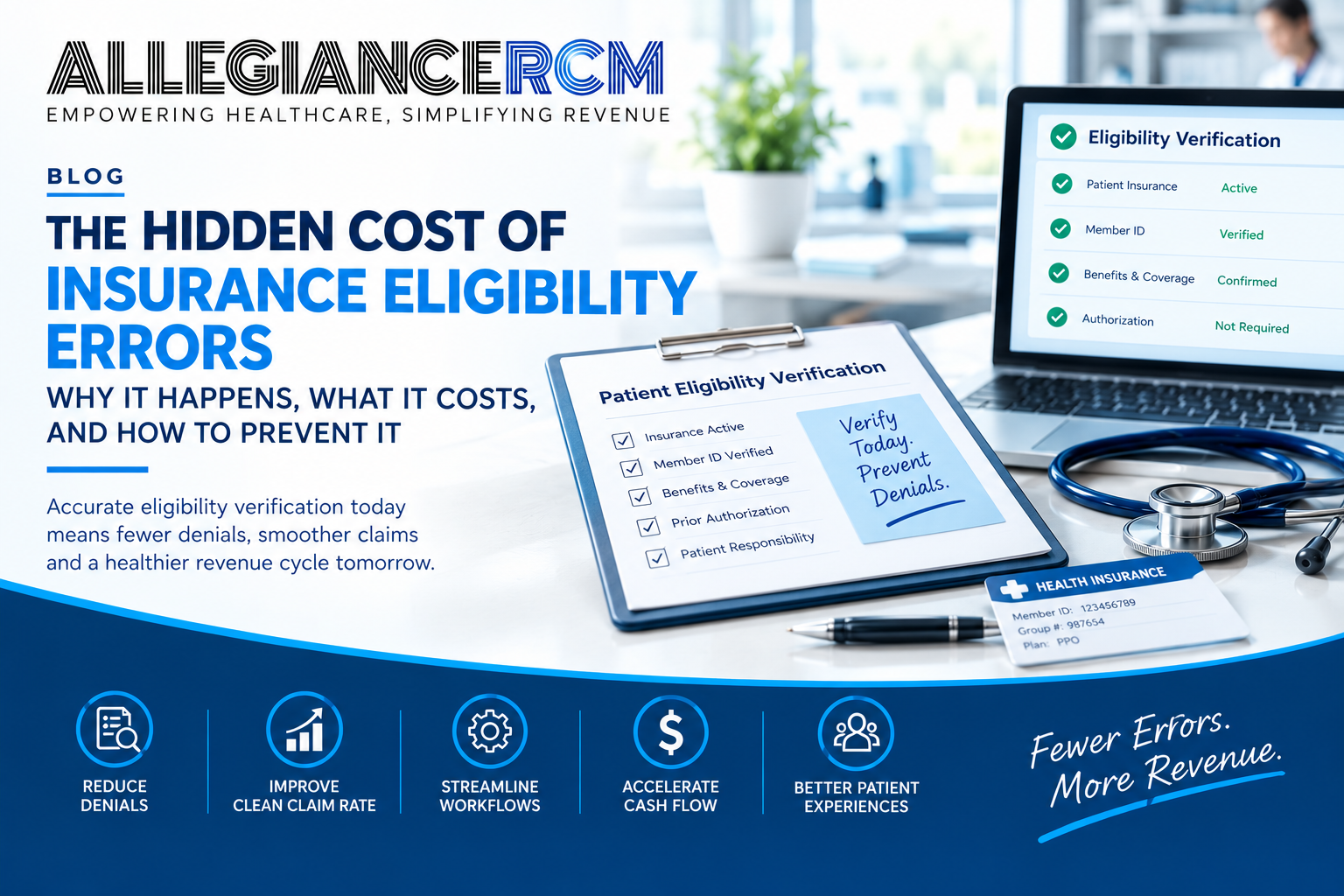
Insurance eligibility verification is often treated as a routine administrative task. It should be viewed as a financial control. Before a patient is seen, the practice needs to know whether coverage is active, which plan is responsible, what benefits apply, whether the provider is participating, and what patient responsibility may exist. Depending on the payer and service, there may also be authorization, referral, deductible, copayment, or coinsurance considerations.
The American Medical Association recommends verifying insurance before every appointment and notes that eligibility information can affect collections and reduce avoidable denials. Its revenue cycle guidance also emphasizes monitoring errors in patient demographics, contact information, and insurance details.
The Medical Group Management Association has similarly identified front-end issues as a major source of revenue cycle leakage. In a January 2026 MGMA Stat poll, front-end problems accounted for 23% of the revenue leakage areas identified by respondents, with eligibility and benefits accuracy, incorrect insurance entry, outdated demographics, and retroactive terminations among the issues reported.
In other words, eligibility verification is not merely about confirming whether a patient has insurance. It is about making sure the claim starts with the right financial information.
The Hidden Cost Is Bigger Than the Denial
Imagine a patient whose insurance coverage terminated at the end of the previous month. The practice does not catch it during registration. The patient receives a $200 office service, the claim is submitted, and the payer rejects it.
The practice has now lost more than the time required to fix one claim.
Someone must identify the rejection. Someone must determine whether the patient has new coverage. Someone may need to call the patient. Billing staff must update the account and determine whether the claim can be resubmitted. If the patient has new insurance, the claim may need to be rebilled to another payer.
And while that is happening, the practice is carrying an unpaid balance.
This is why revenue cycle management is best understood as a connected process rather than a collection of separate billing tasks. A front-end mistake can become a back-end denial, an aging A/R balance, additional staff work, and eventually a patient collection problem.
The Most Common Eligibility Problems
Some eligibility errors are surprisingly simple. A single digit can be wrong in a member ID. A patient’s last name may not match the payer’s records. The date of birth may have been entered incorrectly. A new insurance card may never have been added to the chart. Other problems are more difficult to detect.
A patient’s coverage may have changed since the last appointment. An employer-sponsored plan may have terminated. A newborn may not yet have been added correctly. The patient may have primary and secondary coverage that is recorded in the wrong order. Or the insurance may be active, but the specific service or provider may have different coverage rules.
MGMA’s recent revenue-cycle analysis specifically points to incorrect insurance entry, outdated demographics, retroactive terminations, and delays adding newborns as front-end problems that can cascade into downstream billing and collections issues. That last point is important: an eligibility response is only useful if the practice interprets and acts on it correctly.
Verification Is Not the Same as a Checkbox
One of the easiest mistakes a practice can make is turning eligibility verification into a simple yes-or-no question: “Is the insurance active?” Active coverage does not automatically mean every service will be paid. A stronger eligibility verification process asks additional questions. Is the payer information current? Is the provider or location participating? What are the patient’s copay, deductible, and coinsurance obligations? Is a referral required? Does the planned service require prior authorization? Are there benefit limitations that should be considered?
The exact information available varies by payer and plan, so staff should follow the practice’s workflow and payer-specific requirements rather than assuming that one eligibility response tells the entire story. This is where good medical billing and revenue cycle management become proactive. The goal is to discover a problem before the claim is submitted, when the practice still has an opportunity to correct it. The AMA also recommends electronic eligibility verification and claim-scrubbing processes to identify incorrect or missing information before claims reach the payer.
The Patient Experience Is Part of the Equation
Eligibility errors do not only affect the practice’s finances. They can affect the patient relationship. A patient who believes their insurance is active may be surprised weeks later by a bill for the full charge. The billing department may then have to explain why the claim was not paid. Even when the original error was caused by outdated information, the patient may experience the situation as a billing surprise. For physician practices built on trust and relationships, that matters.
Clear communication at check-in can make a significant difference. If the practice identifies inactive coverage or a mismatch before the visit, staff can give the patient an opportunity to provide updated information. If patient responsibility can be estimated from available eligibility data, discussing it before or at the point of service can also make the eventual bill less surprising. The AMA has highlighted cost transparency and clear explanations of financial responsibility as ways practices can strengthen patient relationships while improving collections.
Building a Better Eligibility Verification Workflow
The strongest insurance verification process is consistent enough that it does not depend on one employee remembering every step. Start by defining when eligibility must be checked. For many practices, that means before every appointment, with additional verification when there is a change in coverage, a new patient, a new insurance card, or a significant change in the planned service.
Next, establish what information needs to be captured. The workflow should address the payer, member ID, patient demographics, coverage status, effective dates, and relevant benefit or responsibility information. Depending on the specialty and service, it may also need to address referrals and prior authorization.
Then create a process for exceptions. What happens when eligibility cannot be confirmed? Who contacts the patient? Who updates the EHR? Who documents the verification? Who checks whether an authorization is required? Technology can help, but automation should support a defined process rather than replace one. The AMA notes that electronic eligibility tools can help practices identify incorrect or missing information before claims reach the payer.
The goal is simple: move error detection as close to the front of the revenue cycle as possible.
Measure the Process, Not Just the Denials
Many practices measure denial rate, but fewer look closely enough at why those denials occurred. If eligibility-related denials are increasing, the practice should ask whether the problem is concentrated around a particular payer, location, provider, registration employee, specialty, appointment type, or patient population.
It is also useful to track the insurance verification rate and the percentage of encounters where eligibility problems are identified before the visit. MGMA’s KPI guidance has cited a 98% or higher insurance verification rate as a benchmark in its revenue-cycle KPI framework.
The point of measurement is not to create another report that nobody reads. It is to find patterns. If ten claims are denied because a particular payer repeatedly returns an eligibility mismatch, the answer may not be “work harder on denials.” The better question is why those mismatches are reaching the claim stage in the first place. That is the difference between denial management and denial prevention.
Where Eligibility Fits Into the Bigger RCM Picture
Eligibility verification cannot operate in isolation. Registration, scheduling, clinical documentation, coding, charge capture, claims submission, denial management, and patient collections all influence one another. A clean claim begins long before the claim reaches the clearinghouse.
The AMA’s revenue cycle resources emphasize this connected workflow, including accurate patient information, timely chart closure, coding, claim submission, and monitoring of claim status. MGMA’s recent revenue-cycle reporting reinforces the same lesson: leakage often begins with small front-end issues that become more expensive problems later.
For practice owners, this is an important mindset shift. Instead of asking, “Why did this claim deny?” it is often more productive to ask, “What could we have known before the patient was seen?” That question leads the practice upstream, where many problems are easier and less expensive to solve.
A Healthier Front End Creates a Healthier Revenue Cycle
Insurance eligibility verification may never be the most visible part of a physician practice. Patients rarely notice when it is done correctly. Staff may consider it just another item on a busy checklist. But when it is done consistently, accurately, and with the right level of detail, it protects something every practice depends on: predictable revenue.
Fewer eligibility errors can mean fewer avoidable claim denials, less rework for billing staff, fewer confusing patient statements, and a smoother path from completed visit to collected payment. That is the real opportunity. A healthier revenue cycle does not always begin with a complicated technology investment or a major operational overhaul. Sometimes it begins with getting the first few pieces of information right.
When the front end is accurate, the rest of the revenue cycle has a stronger foundation. Claims can move more cleanly. Staff can spend less time fixing preventable problems. Patients can receive clearer financial information. And practice owners can spend more time thinking about growth instead of wondering where the next payment is stuck.
At AllegianceRCM, we look at eligibility verification as part of the larger financial picture—not as an isolated administrative task. By connecting front-end accuracy with denial prevention, A/R management, claims follow-up, and overall revenue cycle performance, practices can turn small process improvements into meaningful financial progress.
Because every successful claim has a beginning. And increasingly, that beginning is the moment a patient schedules an appointment.