The Hidden Revenue Leaks Costing Anesthesia Groups Thousands Every Month
In today’s healthcare environment, anesthesia providers face mounting pressure from declining reimbursements, staffing shortages, evolving payer requirements, and increasing compliance scrutiny. While many anesthesia groups focus on negotiating better contracts or increasing case volume, a significant amount of revenue loss often occurs much closer to home—within their own revenue cycle. The most concerning part? Most anesthesia practices don’t even realize it’s happening.
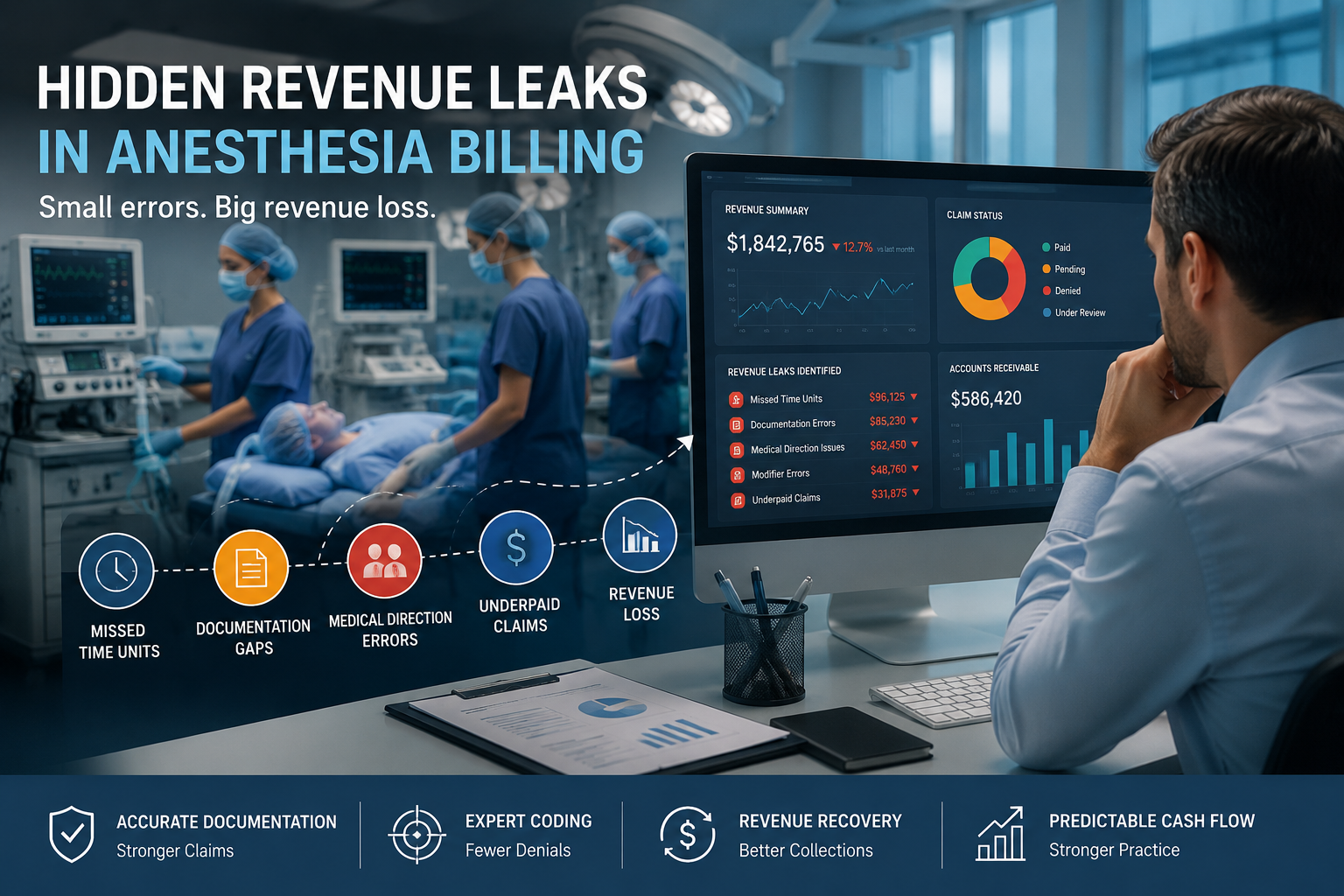
Revenue leakage in anesthesia billing is rarely caused by a single catastrophic mistake. Instead, it typically stems from dozens of small process gaps, documentation inconsistencies, coding errors, missed anesthesia units, and unworked denials that silently erode profitability month after month. For independent anesthesia groups, CRNA practices, hospital-based providers, and ambulatory surgery center (ASC) anesthesia teams, understanding where revenue is being lost is the first step toward recovering it.
At AllegianceRCM, we’ve observed that many anesthesia organizations can significantly improve collections without increasing patient volume simply by optimizing their revenue cycle management processes.
Why Anesthesia Billing Is Uniquely Complex
Unlike many medical specialties that bill based primarily on procedure codes, anesthesia reimbursement depends on a complex formula involving:
- Base Units
- Time Units
- Physical Status Modifiers
- Qualifying Circumstances
- Medical Direction Rules
- Concurrency Requirements
- Payer-Specific Billing Guidelines
A small discrepancy in any of these components can directly impact reimbursement. For example, a missed 15-minute anesthesia unit may seem insignificant in isolation. However, when multiplied across hundreds or thousands of cases annually, the financial impact can become substantial. This complexity makes anesthesia revenue cycle management one of the most specialized areas of medical billing.
Hidden Revenue Leak #1: Inaccurate Time Documentation
Anesthesia reimbursement relies heavily on accurately documented start and stop times.
Unfortunately, providers often encounter:
- Missing anesthesia start times
- Incomplete stop times
- Documentation discrepancies
- Late chart completion
- EHR timestamp inconsistencies
When billing teams cannot validate anesthesia time accurately, claims may be underbilled, delayed, or denied. Consider a busy anesthesia practice performing 1,500 cases annually. Losing just one billable time unit per case can result in tens of thousands of dollars in unrealized revenue over the course of a year. Accurate time capture is one of the simplest yet most overlooked opportunities for revenue optimization.
Hidden Revenue Leak #2: Medical Direction and Concurrency Errors
One of the most scrutinized areas of anesthesia billing involves medical direction and supervision rules.
Incorrect use of modifiers such as:
- AA
- QK
- QX
- QY
- AD
can lead to significant reimbursement reductions and compliance risks.
Many practices struggle with:
- Incomplete physician attestations
- Missing supervision documentation
- Incorrect concurrency tracking
- Failure to document required medical direction steps
Payers and auditors frequently target these areas because even minor documentation deficiencies can trigger claim denials or recoupments. Without active monitoring, practices may unknowingly leave substantial revenue on the table while increasing audit exposure.
Hidden Revenue Leak #3: Delayed Charge Entry
Every day a charge remains unentered is another day reimbursement is delayed. In many anesthesia practices, charge entry delays occur because:
- Providers do not finalize charts promptly
- Documentation remains incomplete
- Case records are missing
- Billing teams are waiting on corrections
The result is slower cash flow and increased accounts receivable aging. Revenue cycle performance begins long before a claim reaches the payer. Efficient workflows between providers, anesthesia departments, and billing teams are essential for maintaining predictable collections. Organizations that monitor charge lag daily typically outperform those relying on weekly or monthly reviews.
Hidden Revenue Leak #4: Missed Qualifying Circumstances and Physical Status Codes
Many anesthesia claims contain additional billable elements that directly impact reimbursement.
These may include:
- Physical Status Modifiers (P1-P6)
- Emergency Conditions
- Extreme Age Circumstances
- Complex Clinical Scenarios
When documentation supports these factors but coding teams fail to capture them appropriately, legitimate reimbursement opportunities are lost. A comprehensive anesthesia coding review process helps ensure that all supported services are accurately represented on the claim.
Hidden Revenue Leak #5: Underworked Denials
Denials represent one of the largest sources of lost revenue in anesthesia billing.
Common anesthesia denial reasons include:
- Authorization issues
- Eligibility errors
- Modifier discrepancies
- Documentation deficiencies
- Bundling edits
- Medical necessity concerns
Many practices focus heavily on claim submission but lack structured denial management processes. When denied claims are not aggressively pursued, recoverable revenue quickly becomes write-offs.
Successful anesthesia revenue cycle management requires:
- Root cause analysis
- Timely appeals
- Payer-specific workflows
- Continuous denial trend monitoring
The goal should not simply be resolving denials but preventing them from occurring in the first place.
Hidden Revenue Leak #6: Payer Contract Underpayments
Many anesthesia providers assume payers are reimbursing correctly. Unfortunately, this assumption is often incorrect. Without regular contract analysis, practices may miss:
- Underpaid claims
- Incorrect fee schedules
- Bundling errors
- Payment posting discrepancies
Over time, these underpayments can accumulate into substantial financial losses. An effective anesthesia billing partner continuously audits payer performance to ensure contracted rates are being honored. Revenue recovery efforts frequently uncover opportunities that internal teams simply do not have the bandwidth to identify.
Hidden Revenue Leak #7: Lack of Meaningful Revenue Cycle Reporting
Many anesthesia groups receive reports every month. The problem is that those reports often fail to provide actionable insights. Practice leaders should have visibility into key performance indicators such as:
- Net Collection Rate
- First Pass Resolution Rate
- Clean Claim Rate
- Days in Accounts Receivable
- Denial Rate
- Charge Lag
- Provider Productivity
- Payer Performance
Without these metrics, identifying revenue leakage becomes nearly impossible. Data-driven decision-making separates high-performing anesthesia organizations from those constantly struggling with cash flow unpredictability.
Real-World Scenario: The Cost of Small Inefficiencies
Imagine an anesthesia group with:
- 15 providers
- 1,200 monthly cases
- Average reimbursement of $425 per case
If documentation errors, missed units, and denial write-offs impact just 3% of potential revenue, the annual loss could exceed: $183,000 per year And that’s a conservative estimate. Most practices are surprised to discover that their greatest financial opportunities often exist within their current operations rather than through adding new providers or increasing case volume.
How Leading Anesthesia Practices Protect Revenue
The most successful anesthesia practices understand that strong financial performance is not achieved solely through increasing case volume or negotiating better payer contracts. Instead, it comes from protecting revenue at every stage of the revenue cycle. High-performing organizations have moved beyond traditional billing approaches and adopted proactive strategies that focus on revenue integrity, compliance, operational efficiency, and continuous performance monitoring.
One of the most important priorities is revenue integrity. Leading anesthesia groups ensure that every billable service is accurately documented, coded, and submitted according to payer-specific requirements. They recognize that even small documentation gaps or missed anesthesia units can accumulate into significant revenue losses over time. By implementing rigorous charge capture and coding review processes, these organizations maximize reimbursement while maintaining compliance.
Equally important is a strong focus on documentation compliance. Successful practices actively monitor provider documentation and chart completion in real time rather than waiting until claims are ready to be submitted. They establish clear expectations for anesthesia records, medical direction attestations, start and stop times, and concurrency documentation. This proactive approach helps prevent claim delays, reduces rework for billing teams, and minimizes audit exposure.
Another defining characteristic of high-performing anesthesia organizations is their commitment to denial prevention. Rather than simply reacting to denials after they occur, these practices continuously analyze denial trends, identify root causes, and implement corrective actions. Whether the issue stems from authorization requirements, modifier usage, documentation deficiencies, or payer-specific edits, they focus on preventing recurring problems before they impact collections and cash flow.
Leading practices also prioritize payer accountability by regularly auditing reimbursements and monitoring contract compliance. They do not assume that every payment received is correct. Instead, they compare payments against contracted rates, investigate underpayments, and identify patterns that may indicate payer processing issues. This level of oversight often uncovers revenue opportunities that would otherwise remain hidden.
Finally, top-performing anesthesia groups maintain a high degree of operational visibility through detailed analytics and performance reporting. They track key metrics such as clean claim rates, denial percentages, days in accounts receivable, charge lag, and net collection rates. These insights allow leadership teams to make informed decisions, identify bottlenecks quickly, and address issues before they negatively affect revenue.
Ultimately, these organizations understand that successful anesthesia billing is about far more than simply submitting claims. It requires a comprehensive strategy focused on protecting revenue, ensuring compliance, improving operational efficiency, and creating predictable financial outcomes. By treating revenue cycle management as a strategic function rather than an administrative task, leading anesthesia practices position themselves for long-term growth and profitability.
Why Strategic RCM Partnerships Matter
As anesthesia billing grows increasingly complex, many organizations are turning to specialized revenue cycle management partners that understand the unique requirements of anesthesia reimbursement.
An experienced anesthesia billing partner provides:
- Specialized anesthesia coding expertise
- Medical direction compliance oversight
- Denial management programs
- Revenue analytics and reporting
- Charge capture optimization
- Accounts receivable management
- Payer underpayment monitoring
Most importantly, they help anesthesia providers focus on patient care while ensuring financial performance remains strong.
Final Thoughts
Many anesthesia practices assume their billing performance is healthy because claims are being submitted and payments are arriving. However, the true question is not whether claims are being paid.
The real question is whether you’re collecting every dollar you’ve earned. Hidden revenue leaks often remain invisible until organizations conduct a detailed review of their workflows, documentation practices, coding accuracy, denial management processes, and payer performance.
The good news is that most of these issues are entirely fixable. At AllegianceRCM, we help anesthesia groups, CRNA organizations, ambulatory surgery centers, and hospital-based anesthesia providers identify hidden revenue opportunities, reduce denials, improve collections, and create predictable financial outcomes through specialized anesthesia revenue cycle management solutions. Because protecting revenue isn’t just about billing claims—it’s about building a stronger, more profitable practice.