Key Takeaways
- Low-cost RCM services often create hidden operational and financial problems that appear months later.
- The true cost of “cheap billing” shows up in denials, delayed reimbursements, poor follow-up, and lost revenue.
- A strategic RCM partner should improve workflows, collections, compliance, and provider satisfaction—not just submit claims.
- Investing in experienced, scalable RCM support protects long-term practice growth and financial stability.
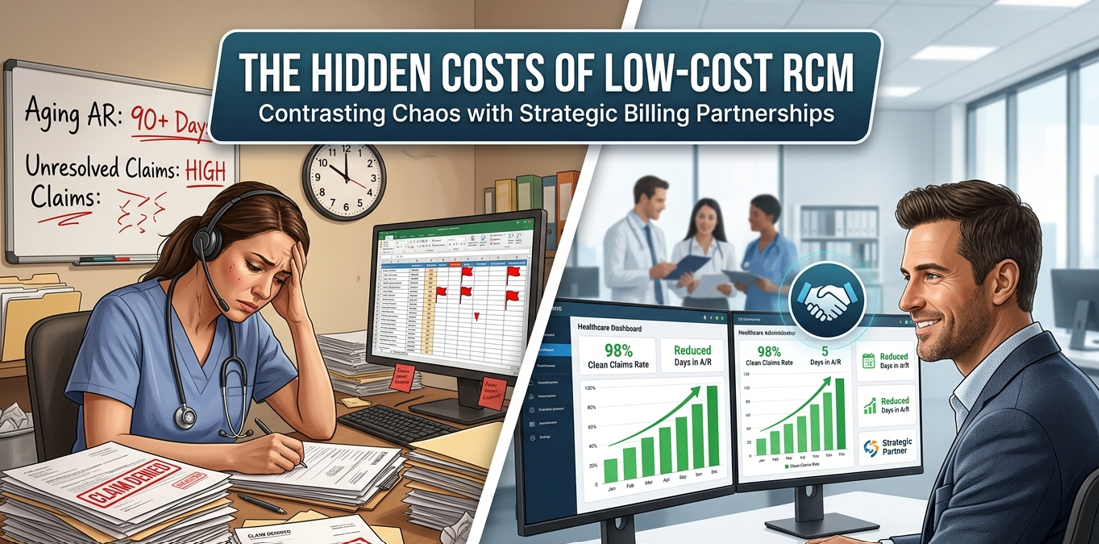
At first glance, low-cost medical billing services can seem like an easy decision for a healthcare practice trying to reduce overhead. Many providers—especially startups and growing clinics—are naturally drawn toward vendors offering extremely low percentages or flat monthly pricing. On paper, it appears to be a smart financial move. But over time, many practices discover that inexpensive RCM services often come with hidden operational gaps that quietly drain revenue, increase staff frustration, and slow practice growth.
The reality is that revenue cycle management is not just about claim submission. A true RCM partnership impacts every stage of the patient financial journey—from eligibility verification and coding accuracy to denial management, accounts receivable follow-up, patient collections, reporting, and compliance oversight. When any of these components are handled poorly, the financial consequences compound quickly.
Before choosing an RCM partner based purely on price, providers should understand what they may actually be sacrificing behind the scenes.
The Real Cost of Poor Onboarding and Transition
One of the first places where “cheap” RCM vendors fall short is onboarding. Many low-cost billing companies focus heavily on signing clients quickly but invest very little in understanding workflows, payer behavior, specialty requirements, or existing AR challenges.
This often leads to:
- Incomplete transition planning
- Missed payer enrollments or credentialing gaps
- Delayed claim submissions during onboarding
- Lack of workflow customization
- Confusion between office staff and billing teams
As a result, practices experience operational disruption at the exact moment they expected improvement.
A proper RCM transition should include workflow analysis, payer review, AR assessment, staff coordination, reporting setup, and clear communication channels from day one. Without this foundation, practices often spend months recovering from avoidable errors and revenue delays.
Workflow Disruptions: The Hidden Revenue Killer
Many providers assume all billing companies perform the same basic tasks. However, the quality of workflow management dramatically impacts reimbursement speed and denial rates.
Cheap RCM services often rely on:
- High-volume, low-attention workflows
- Generic billing processes across all specialties
- Limited payer follow-up
- Reactive denial handling
- Minimal provider communication
The result is a revenue cycle that technically functions—but inefficiently.
Claims sit unresolved for weeks. Documentation requests go unnoticed. Eligibility issues are discovered after claims deny. Front-office staff become overwhelmed trying to bridge communication gaps between providers and billers.
Over time, these inefficiencies create:
- Slower reimbursements
- Increased AR aging
- Higher denial percentages
- Staff burnout
- Patient dissatisfaction
The cost of operational inefficiency is rarely visible on an invoice, but it significantly impacts practice profitability.
The “Low Percentage” Trap
One of the most common marketing tactics in the billing industry is offering extremely low collection percentages to win business. While this may sound attractive initially, providers often discover hidden trade-offs later.
Some low-cost RCM companies compensate by:
- Limiting the scope of services
- Charging separately for credentialing or reporting
- Ignoring smaller-denial claims
- Providing minimal AR follow-up
- Using inexperienced staff for complex accounts
In many cases, practices actually collect less overall despite paying a lower percentage.
A slightly higher-performing RCM team that improves clean claim rates, accelerates reimbursements, and aggressively follows up on aging claims often generates significantly higher net revenue—even if the service fee itself appears higher.
The focus should never be solely on “what percentage am I paying?” but rather:
“How much revenue am I actually keeping?”
Denial Management: Where Cheap Billing Becomes Expensive
Denial management is one of the clearest differences between transactional billing companies and strategic RCM partners.
Many low-cost vendors simply resubmit basic denials while ignoring deeper root causes. Complex appeals, coding corrections, payer escalations, and documentation follow-ups require experienced staff and time-intensive effort—resources that inexpensive vendors often cannot afford to allocate properly.
This creates a dangerous cycle:
- Denials increase
- Claims age longer
- Revenue gets written off
- Staff spend more time troubleshooting
- Cash flow becomes unpredictable
Strong denial management is not just about fixing rejected claims. It is about preventing recurring issues by identifying workflow weaknesses, training gaps, and payer-specific trends before they become costly problems.
Poor Reporting Creates Blind Spots
Another hidden cost of cheap RCM services is the lack of meaningful reporting and financial visibility.
Many practices receive only basic summaries showing charges and payments without deeper insights into:
- Denial trends
- AR aging performance
- Underpayment analysis
- Payer turnaround times
- Collection efficiency
- Front-end workflow issues
Without accurate reporting, providers operate blindly. Leadership cannot identify bottlenecks, track financial performance, or make informed operational decisions.
A strong RCM partner should provide actionable reporting that helps practices improve—not just numbers exported from a billing system.
Compliance Risks and Long-Term Damage
Revenue cycle management is closely tied to compliance. Coding errors, documentation inconsistencies, improper billing practices, and missed payer updates can expose practices to audits, penalties, and repayment demands.
Low-cost vendors often struggle to maintain:
- Ongoing staff training
- Specialty-specific coding expertise
- Compliance monitoring
- Quality assurance workflows
- Regulatory updates
In healthcare, small mistakes repeated consistently can create major financial and legal exposure over time.
Providers need RCM partners who prioritize accuracy, compliance, and long-term stability—not just claim volume.
What a Strategic RCM Partner Provides
An experienced RCM company does far more than process claims. A true strategic partner helps practices optimize operations, improve cash flow, and scale sustainably.
A robust RCM partnership includes:
- Dedicated account management
- Specialty-focused billing workflows
- Proactive denial prevention
- Aggressive AR follow-up
- Real-time reporting and analytics
- Credentialing and payer enrollment support
- Compliance oversight
- Workflow optimization recommendations
- Transparent communication
Most importantly, the right RCM partner becomes an extension of the practice itself—not an outsourced afterthought.
Choosing Long-Term Value Over Short-Term Savings
Healthcare providers today operate in an increasingly complex financial environment. Rising denial rates, staffing shortages, evolving payer rules, and growing patient responsibility have made revenue cycle performance more important than ever.
While low-cost billing services may appear attractive initially, the hidden costs often surface later through lost revenue, workflow disruption, poor collections, and operational frustration.
Instead of asking:
“What is the cheapest RCM service available?”
Providers should ask:
- Will this partner improve my collections?
- Do they understand my specialty?
- Can they scale as my practice grows?
- Will they actively reduce denials and AR?
- Do they operate as a strategic extension of my team?
At AllegianceRCM, we believe revenue cycle management should create stability, visibility, and growth—not additional stress. The right RCM partnership is not an expense. It is an investment in the long-term financial health of your practice.