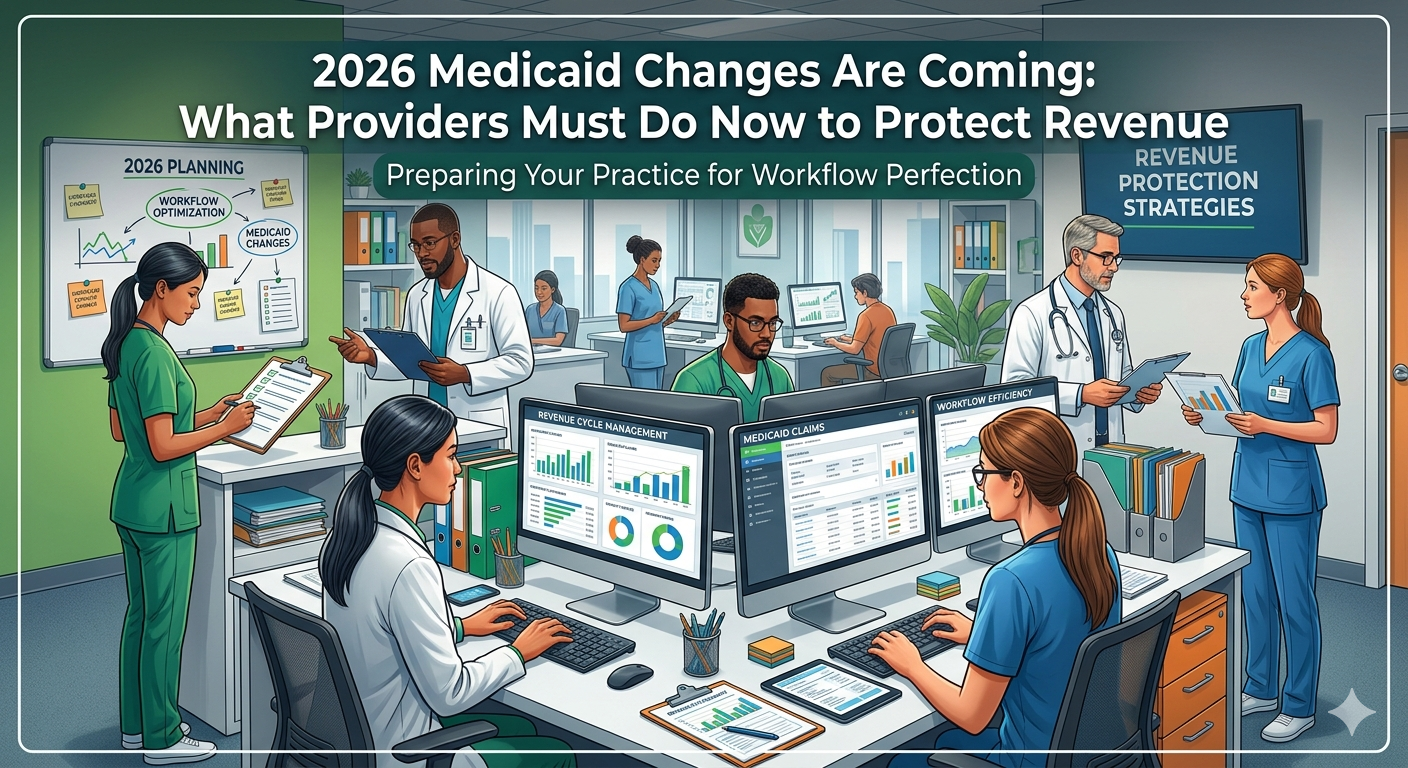
For healthcare providers serving Medicaid populations, 2026 is shaping up to be one of the most operationally challenging years in recent memory. New federal legislation and evolving state-level Medicaid policies are set to significantly change how eligibility is verified, how patients maintain coverage, and how providers manage reimbursement risk. While many organizations are focused on clinical delivery and staffing shortages, a quieter but equally serious challenge is emerging in the background: the growing complexity of Medicaid compliance and revenue cycle management.
For providers, these changes are not just policy updates—they represent real financial exposure. Increased eligibility churn, more frequent redeterminations, shrinking retroactive coverage windows, and stricter documentation requirements are expected to increase denials, delay payments, and create additional strain on front-end operations. Practices that fail to prepare early may find themselves dealing with rising accounts receivable, higher uncompensated care, and frustrated patients who unexpectedly lose coverage.
One of the most discussed changes involves the introduction of work and community engagement requirements for many Medicaid expansion beneficiaries. Beginning in 2027, adults between certain age groups may be required to complete a minimum number of monthly hours through employment, education, training, or community-based activities to maintain coverage eligibility. While the intention behind the policy is to increase accountability, the practical reality is that many patients may struggle to understand or navigate the reporting process. Historically, Medicaid coverage losses have often occurred not because patients were truly ineligible, but because administrative requirements became too difficult to manage. For providers, this creates a major risk of eligibility disruption and delayed reimbursement.
Primary care practices, behavioral health organizations, community health centers, and specialty providers serving Medicaid-heavy populations will likely feel the impact first. Patients who unknowingly lose coverage may continue receiving services without realizing their benefits have lapsed, leaving providers with denied claims and difficult collection situations. Front-desk teams and eligibility staff will become increasingly important in identifying these risks before claims are submitted. Practices that continue relying on outdated verification workflows or infrequent eligibility checks may experience a sharp increase in preventable denials.
Another major operational shift is the move toward more frequent Medicaid redeterminations. Traditionally, many Medicaid beneficiaries only had to renew eligibility annually. Under the evolving framework, certain populations may now undergo eligibility reviews twice per year. While this may appear to be a minor procedural update, it dramatically increases the number of opportunities for coverage interruptions. A missed renewal notice, delayed paperwork submission, or documentation mismatch can quickly result in temporary or permanent loss of benefits. For providers, this means eligibility verification can no longer be viewed as a one-time process completed during registration—it must become an ongoing operational priority.
The reduction in retroactive coverage windows is another area providers cannot afford to ignore. Historically, retroactive eligibility often acted as a financial safety net, allowing providers to recover reimbursement for services rendered before Medicaid approval was finalized. As these windows shrink, providers face increased financial risk for services delivered without confirmed active coverage. This places even greater pressure on intake accuracy, pre-service verification, and real-time payer checks. Practices with weak front-end workflows may see a rise in unrecoverable balances and patient disputes.
Documentation requirements are also expected to become more stringent. Medicaid programs are increasing oversight around income verification, residency validation, and compliance documentation. This means providers and administrative teams will likely spend more time assisting patients with paperwork and responding to payer requests. Unfortunately, increased administrative burden often leads to workflow slowdowns, staff fatigue, and inconsistent follow-up if processes are not carefully structured. Healthcare organizations already operating with lean staffing models may struggle to keep pace without additional operational support.
Beyond eligibility and compliance concerns, providers should also begin preparing for increased patient financial responsibility in future years. As certain Medicaid populations face new cost-sharing requirements and co-pay structures, practices may encounter growing challenges around patient collections and bad debt management. While these changes may not fully take effect immediately, proactive planning is essential. Providers that educate patients early, improve financial transparency, and implement structured collection workflows will be in a far stronger position than those reacting after balances begin accumulating.
What makes these changes particularly challenging is that they affect both operational workflows and financial performance simultaneously. Increased denials lead to more rework, higher AR aging, slower reimbursements, and added pressure on already overwhelmed staff. Without a proactive strategy, organizations can quickly find themselves trapped in a reactive cycle where teams spend more time fixing problems than preventing them.
This is why many healthcare organizations are now re-evaluating their revenue cycle infrastructure ahead of 2026. Automated eligibility verification, real-time insurance checks, proactive renewal tracking, denial trend analysis, and structured patient communication workflows are no longer optional enhancements—they are becoming essential survival tools for providers serving Medicaid populations. Organizations that modernize their workflows early will be better positioned to protect cash flow, maintain continuity of care, and reduce administrative chaos.
At the same time, healthcare leaders are increasingly recognizing the value of experienced RCM partners who understand the evolving Medicaid landscape. A strategic revenue cycle partner can help providers monitor eligibility changes, strengthen intake accuracy, improve denial prevention strategies, and maintain consistent payer follow-up. More importantly, outsourcing complex administrative functions allows internal teams to remain focused on patient care instead of becoming overwhelmed by growing compliance demands.
For organizations serving vulnerable populations, these changes also carry an important patient care dimension. Coverage disruptions often result in delayed treatment, missed follow-ups, and worsening health outcomes. Providers that proactively support patients through eligibility and renewal processes not only protect revenue but also strengthen patient trust and continuity of care.
The healthcare organizations that succeed in 2026 will not necessarily be the largest or the busiest—they will be the most operationally prepared. Medicaid policy changes are expected to create significant disruption across the industry, but they also present an opportunity for providers to strengthen workflows, improve revenue cycle efficiency, and build more resilient operations for the future.
The time to prepare is now. Practices that wait until denials rise and reimbursements slow down may find themselves struggling to recover lost revenue. Those that act early, invest in workflow optimization, staff training, and strategic RCM support will be in a far stronger position to navigate the changing Medicaid landscape with confidence.