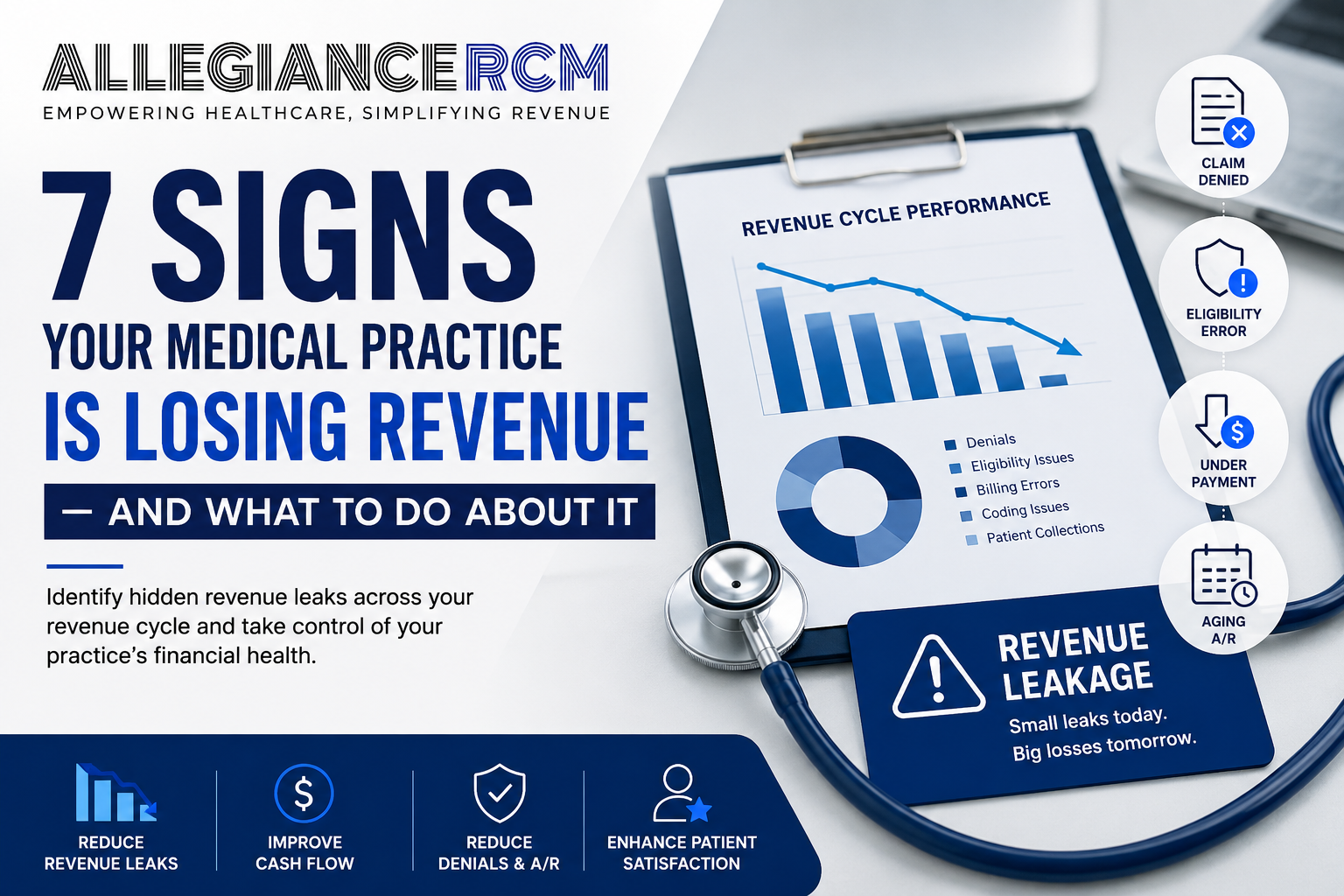
Your Practice May Be Losing Revenue Without Realizing It
Your schedule is full. Your physicians are seeing patients. Claims are being submitted. Payments are coming in. So why does the practice still feel like it is constantly fighting to maintain cash flow?
For many physician practices, the problem isn’t necessarily a lack of patients or even a lack of claims being submitted. The problem is revenue leakage.
Revenue leakage happens when money that a practice has legitimately earned is delayed, reduced, denied, underpaid, written off, or never collected. And the frustrating part is that revenue leakage can happen at almost every stage of the revenue cycle—from the moment a patient schedules an appointment to the moment the final payment is posted.
Recent industry data underscores the problem. In a January 2026 MGMA Stat poll, 48% of respondents identified denials and appeals as the biggest source of revenue-cycle leakage, while another 23% pointed to front-end issues such as eligibility and benefits verification. Billing and collections, coding, and charge posting accounted for additional leakage.
In other words, the problem usually isn’t one broken process. It is often a chain of small problems that eventually become a significant financial loss. Here are seven warning signs that your practice may have revenue leakage—and what you can do about them.
1. Your 90+ Day A/R Keeps Growing
One of the clearest warning signs is an aging accounts receivable balance that keeps moving in the wrong direction. Your A/R report should tell you more than how much money is outstanding. It should tell you how quickly your practice is converting services into cash.
If a significant portion of your A/R is sitting in the 90+ day bucket, your practice has more than an accounting problem. You have money tied up that could otherwise be supporting payroll, technology, staffing, expansion, or other operational priorities. The AMA’s physician RCM guidance recommends that practices actively monitor days in A/R and work toward collecting outstanding payments within approximately 30 days.
What to look for
Review your A/R by aging bucket:
- 0–30 days
- 31–60 days
- 61–90 days
- 91–120 days
- 120+ days
Then ask, What percentage of our total A/R is older than 90 days? and more importantly, Why is it there? A healthy A/R strategy isn’t simply about working old claims. It’s about identifying why claims are becoming old in the first place.
What to do
Segment your aged A/R by:
- Payer
- Denial reason
- Provider
- CPT/service category
- Date of service
- Patient responsibility
- Claim status
Patterns will often emerge quickly.
2. Your Denial Rate Is High—or Nobody Can Explain It
A denial is not simply a claim that didn’t get paid. It is a signal. It tells you that something went wrong somewhere in the revenue cycle. And if the same denial appears repeatedly, simply reworking the claim isn’t enough. You need to identify and eliminate the underlying cause. MGMA’s January 2026 data placed denials and appeals at the top of the list of revenue-cycle leakage problems reported by medical groups and the common causes include:
- Eligibility problems
- Incorrect patient information
- Missing authorization
- Coding errors
- Modifier issues
- Medical necessity
- Documentation problems
- Timely filing
- Incorrect payer selection
- Duplicate claims
- Coordination of benefits
- Incorrect provider information
The important question isn’t:
“How many claims were denied?” It’s: “Why were they denied, and are the same reasons happening repeatedly?” Track your denial rate by payer and denial reason, not just as one overall percentage. A blended denial rate can hide a serious problem with one particular payer, provider, procedure, or workflow.
3. Your Staff Is Constantly “Chasing Claims”
Does your billing team spend a large part of every week:
- Calling insurance companies
- Checking claim status
- Resubmitting claims
- Appealing denials
- Correcting demographic information
- Searching for authorization information
- Fixing eligibility errors
- Answering payer requests?
Some follow-up is unavoidable. But excessive manual follow-up can indicate that problems are being created upstream. Think about the revenue cycle as a pipeline. If the front end is producing incomplete or inaccurate information, the billing team inherits the problem weeks later.
For example: Eligibility error → claim denial → billing follow-up → appeal → delayed payment
One front-end mistake can therefore consume staff time several times over.
What to do
Don’t only measure how many claims your team works but instead measure, How many preventable problems are entering the billing queue? That’s where meaningful improvement begins.
4. Your Eligibility and Benefits Verification Is Inconsistent
A patient can have an insurance card that looks valid and still have:
- Inactive coverage
- Incorrect member information
- A different primary payer
- A deductible that hasn’t been met
- Coinsurance requirements
- Copay requirements
- Out-of-network limitations
- Referral requirements
- Prior authorization requirements
If eligibility isn’t verified accurately and consistently before the visit, the practice can end up discovering coverage problems after services have already been provided. That creates both a revenue problem and a patient-experience problem. The MGMA data reinforces the importance of front-end processes: eligibility and benefits verification were identified as the second-largest category of revenue-cycle leakage in its January 2026 poll.
What to do
Build a standardized eligibility workflow that verifies:
- Patient demographics
- Member ID
- Group number
- Coverage status
- Effective dates
- Copay
- Deductible
- Coinsurance
- Out-of-pocket responsibility
- Referral requirements
- Authorization requirements
- Network status
The objective isn’t simply to verify insurance. It’s to know what is likely to happen financially before the service is delivered.
5. Your Practice Is Getting Paid—But You Don’t Know If You’re Getting Paid Correctly
This is one of the quieter forms of revenue leakage. A claim can be: submitted → processed → paid and still be underpaid. If your practice doesn’t compare payer payments against contracted reimbursement rates, you may never know.
Consider a simplified example.
Your contracted allowable amount for a service is $100, the payer pays $82, the claim isn’t denied. The payment posts – your team moves on. But if the contract allows $100, the missing $18 represents potential revenue that may deserve investigation. Multiply that across hundreds or thousands of claims and the financial impact can become substantial.
What to do
Implement periodic payment and contract variance analysis.
Review:
- Expected reimbursement
- Actual reimbursement
- Contractual adjustments
- Payer
- CPT/HCPCS
- Provider
- Location
- Date of service
This turns payment posting from a purely administrative function into a source of revenue intelligence.
6. Your Patient Balances Are Growing Faster Than Your Collections
Insurance isn’t the only source of practice revenue. Patients increasingly carry meaningful financial responsibility. That makes patient collections an important component of the modern revenue cycle. But collecting from patients requires more than sending a statement.
Patients may not understand:
- What they owe
- Why they owe it
- Whether insurance processed the claim
- What their deductible means
- Why two services generated different balances
- How to pay
- Who to contact with questions
A confusing financial experience can create unnecessary friction.
The goal shouldn’t be:
“Collect as much as possible.” The goal should be, “Make it as easy as possible for patients to understand and resolve their financial responsibility.”
That means looking at:
- Clear statements
- Timely billing
- Convenient payment options
- Accurate insurance processing
- Pre-service financial communication
- Consistent follow-up
- Appropriate payment plans where applicable
Better patient financial communication can support both collections and patient satisfaction.
7. Your Practice Measures Collections—but Not the Processes Behind Them
This may be the biggest warning sign of all. If the only number leadership regularly reviews is, “How much did we collect this month?” you’re looking at the end of the story. Collections are a lagging indicator. By the time collections fall, the underlying problem may have occurred weeks or months earlier.
A stronger revenue-cycle dashboard should include leading and operational indicators such as:
- Clean claim rate
- First-pass resolution
- Denial rate
- Denial reasons
- Days in A/R
- A/R aging
- 90+ day A/R
- Net collection rate
- Charge lag
- Payment turnaround
- Eligibility error rate
- Authorization turnaround
- Patient collection rate
- Underpayment trends
The AMA’s physician RCM guidance similarly emphasizes monitoring metrics such as first-pass resolution, denial volume, denial appeals and days in A/R. The objective is to move from, “How much did we collect?” to “What is affecting our ability to collect?” That is a much more powerful management question.
Revenue Leakage Is Usually a System Problem
The biggest mistake a practice can make is assuming that revenue leakage belongs exclusively to the billing department. It doesn’t. Revenue performance is influenced by almost every part of the practice.
Scheduling affects patient volume > Registration affects data quality > Eligibility affects claim accuracy > Authorization affects whether services can be reimbursed > Clinical documentation affects coding > Coding affects claim submission. Billing affects clean claims > Denial management affects recovery > A/R follow-up affects cash flow > Patient collections affect the final balance. The revenue cycle is connected and that’s why fixing only one part of it often produces limited results.
A Simple Revenue Cycle Health Check
If you’re a physician or practice administrator, ask your team these seven questions:
1. What percentage of our A/R is over 90 days?
2. What are our top five denial reasons?
3. Which payers generate the most denials?
4. What percentage of claims are accepted cleanly on the first submission?
5. Are we consistently verifying eligibility before services?
6. Are we auditing payer payments against contracted rates?
7. Can leadership see these numbers every month?
If you don’t have clear answers, that’s not necessarily a sign that your team is performing poorly. It may be a sign that your practice doesn’t have enough revenue-cycle visibility. And you can’t reliably improve what you can’t measure.
What a Stronger Revenue Cycle Looks Like
An effective RCM operation doesn’t simply react to problems.
- It identifies patterns.
- It doesn’t just work denials.
- It prevents recurring denials.
- It doesn’t just chase A/R.
- It identifies why A/R is aging.
- It doesn’t simply verify insurance.
- It uses eligibility information to reduce downstream financial problems.
- It doesn’t just post payments.
- It analyzes whether payments are accurate.
And it doesn’t wait until monthly collections fall to discover that something is wrong. It monitors the leading indicators. That is the difference between processing revenue and managing a revenue cycle.
How AllegianceRCM Helps Practices Find and Fix Revenue Leakage
At AllegianceRCM, we look at revenue cycle performance as a connected process rather than a collection of isolated billing tasks.
Our approach can include:
- Medical billing and claims management
- Eligibility and benefits verification
- Prior authorization support
- Medical coding and coding review
- Denial management
- A/R follow-up
- Underpayment identification
- Patient collections support
- Credentialing and enrollment
- Revenue-cycle reporting and KPI monitoring
The objective isn’t simply to process more claims.
It’s to help practices reduce preventable revenue loss, accelerate reimbursement, improve visibility and create a more predictable revenue cycle. For practices that aren’t sure where their biggest revenue leaks are, a structured RCM assessment can be a useful starting point.
The Bottom Line
A practice doesn’t have to be losing millions of dollars for revenue leakage to matter. A few recurring eligibility errors. A handful of preventable denials. Slow claim submission. Unworked aged A/R. Underpayments that aren’t being identified. Patient balances that aren’t being followed up.
Individually, each problem may look small. Together, they can have a meaningful impact on practice profitability and cash flow. Your practice may not need more patients. It may need to collect more effectively from the care you’re already providing. The first step is understanding where the money is getting stuck.
Is Your Revenue Cycle Performing as Well as It Should?
AllegianceRCM helps healthcare providers identify revenue-cycle bottlenecks, reduce preventable denials, manage A/R and improve the financial performance of their practices.
Want to know where your revenue may be leaking? Request a Revenue Cycle Health Check from AllegianceRCM.
This article is intended for general educational purposes and does not constitute legal, coding, reimbursement, or compliance advice. Payer policies, contracts and reimbursement requirements vary by provider, specialty and plan.