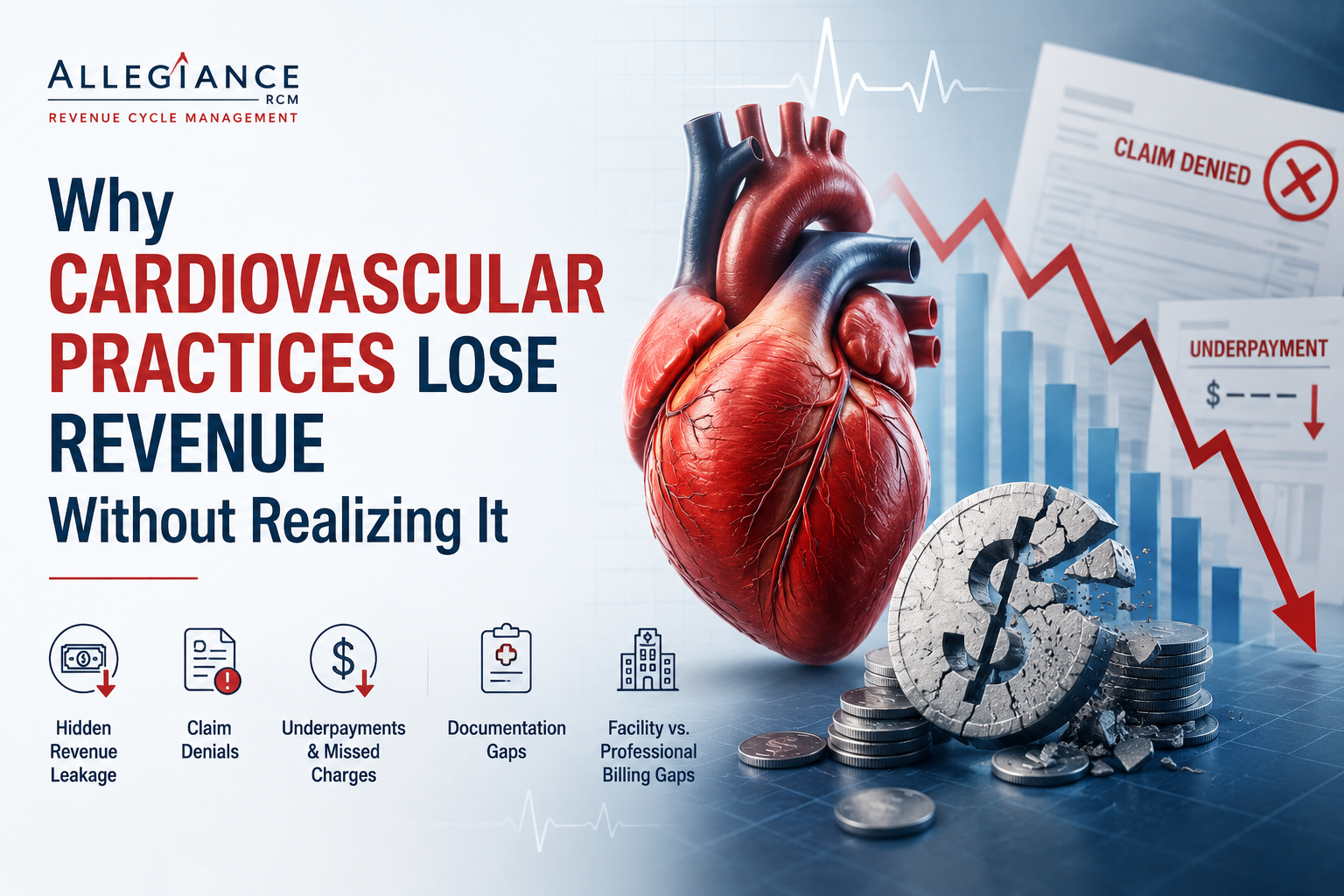
Cardiovascular practices operate in one of the most clinically sophisticated and financially complex specialties in healthcare. Whether performing peripheral vascular interventions, diagnostic angiography, vein procedures, endovascular treatments, or office-based lab (OBL) procedures, providers invest significant resources into delivering high-quality patient care. Yet many practices are surprised to discover that revenue loss often occurs not because they are seeing too few patients, but because revenue is quietly leaking from their existing operations.
The challenge is that most revenue leakage does not appear on a financial statement labeled “lost revenue.” Instead, it hides within underpayments, documentation gaps, missed charges, denied claims, authorization issues, aging accounts receivable, and reimbursement discrepancies. By the time leadership notices a cash flow problem, the root cause may have existed for months.
Recent MGMA research found that denials and appeals remain the largest source of revenue cycle leakage for healthcare organizations, followed by front-end eligibility issues, coding deficiencies, and billing inefficiencies. The findings reinforce what many specialty practices are already experiencing: financial performance is often determined by operational discipline rather than patient volume alone.
Revenue Leakage Is More Common Than Most Practices Realize
Many cardiovascular organizations assume that if claims are being submitted and payments are arriving, the revenue cycle is functioning properly. Unfortunately, that assumption can be costly. Revenue leakage occurs whenever a practice fails to collect the full amount it has earned for services already provided. Unlike outright claim denials, these losses are often subtle and difficult to detect.
- A claim may be paid, but underpaid.
- A procedure may be performed, but not fully charged.
- Documentation may support a higher level of reimbursement than what was ultimately billed.
- An authorization issue may delay payment long enough to create cash flow challenges.
Each individual issue may seem minor. Collectively, however, they can represent hundreds of thousands of dollars in lost annual revenue for a growing cardiovascular practice.
The Healthcare Financial Management Association (HFMA) notes that revenue leakage can occur throughout the entire revenue cycle—from patient registration and eligibility verification to coding, claim submission, payment posting, and denial management. Even small process failures can significantly impact reimbursement and cash flow.
The Cost of Missed Charges in Cardiovascular Billing
One of the most overlooked sources of revenue loss is incomplete charge capture. Cardiovascular and vascular procedures often involve multiple billable components, including physician services, imaging guidance, diagnostic testing, supplies, devices, facility fees, and procedural interventions. If any element is omitted or incorrectly documented, reimbursement may be reduced without triggering an obvious denial.
Consider a common scenario involving a peripheral intervention performed in an office-based lab. The physician performs the procedure successfully, documentation is completed, and a claim is submitted. Months later, leadership reviews collections and assumes everything was reimbursed appropriately.
What they may not realize is that a separately billable component was never captured, resulting in permanent revenue loss. Because these omissions frequently occur before claims are generated, they often go unnoticed unless regular revenue integrity audits are performed.
Documentation Gaps Continue to Drive Revenue Loss
Clinical excellence alone does not guarantee reimbursement. Payers increasingly require documentation that clearly demonstrates medical necessity, procedural details, treatment rationale, and compliance with payer-specific guidelines. Even when providers perform appropriate services, insufficient documentation can result in downcoding, underpayments, or denials.
HFMA identifies incomplete documentation as one of the leading contributors to reimbursement challenges across healthcare organizations. Missing details during documentation and coding can directly impact payment accuracy and overall revenue performance.
In cardiovascular medicine, documentation requirements are especially demanding. Providers must often document:
- Vessel selection
- Laterality
- Medical necessity
- Imaging findings
- Procedure details
- Device utilization
- Operative notes
- Follow-up recommendations
When documentation fails to support the services billed, reimbursement becomes vulnerable. The issue becomes even more significant in multi-provider practices where documentation habits vary between physicians. Without ongoing monitoring and education, documentation inconsistencies can create unpredictable reimbursement outcomes.
The Underpayment Problem Nobody Is Looking For
Most practices invest substantial resources into denial management. Far fewer invest resources into identifying underpayments – this is a critical distinction. A denied claim creates an immediate task because payment never arrives. An underpaid claim, however, often appears resolved because a payment was received. The account closes, staff move on, and leadership assumes reimbursement was accurate.
According to HFMA analyses, underpayments represent one of the most overlooked forms of revenue leakage in healthcare. Organizations frequently discover significant reimbursement variances only after conducting detailed payment audits. For cardiovascular practices dealing with complex payer contracts and high-dollar procedures, even small reimbursement discrepancies can accumulate quickly.
Without routine payer audits and contract compliance reviews, practices may unknowingly leave substantial revenue uncollected.
OBL and ASC Billing Create Additional Complexity
The migration of cardiovascular procedures from hospitals to office-based labs and ambulatory surgery centers has created tremendous opportunities for providers and patients alike. However, it has also introduced new billing challenges.
Many cardiovascular organizations now manage multiple reimbursement streams simultaneously, including:
- Professional billing
- Facility billing
- Supply reimbursement
- Device reimbursement
- Ancillary service billing
Each revenue stream carries unique coding, documentation, and payer requirements. A disconnect between professional and facility billing workflows can result in missing charges, delayed claims, or reimbursement inconsistencies. As practices expand their procedural offerings, revenue cycle oversight becomes increasingly important.
Organizations that lack visibility into these processes often experience financial leakage without recognizing its source.
Denials Are Often Symptoms, Not Root Causes
When claim denials occur, many organizations focus exclusively on the denial itself. The better question is: why did the denial occur in the first place?
HFMA emphasizes that denials are frequently the result of breakdowns occurring much earlier in the revenue cycle. Eligibility verification errors, authorization deficiencies, documentation gaps, coding inaccuracies, and registration mistakes can all contribute to downstream denials.
Similarly, MGMA’s recent revenue cycle polling found that denial issues often stem from preventable operational challenges involving eligibility verification, coding, medical necessity documentation, prior authorizations, and payer-specific requirements.
For cardiovascular practices, where a single procedure may represent thousands of dollars in reimbursement, even a small denial rate can have a significant financial impact.
Why Revenue Integrity Audits Matter
Many organizations perform financial reviews only after problems become visible. By that point, opportunities may already be lost. Revenue integrity audits provide a proactive way to identify vulnerabilities before they impact reimbursement. Rather than focusing solely on collections, these reviews examine the entire revenue cycle to uncover hidden inefficiencies.
A comprehensive audit typically evaluates:
- Charge capture accuracy
- Documentation compliance
- Coding integrity
- Authorization workflows
- Denial patterns
- Underpayment trends
- Accounts receivable performance
- Payer reimbursement accuracy
The goal is not merely to recover revenue but to prevent future leakage. Practices that routinely audit their revenue cycle often identify recurring issues that would otherwise remain hidden for years.
Building a Financially Stronger Cardiovascular Practice
The most successful cardiovascular organizations recognize that financial performance extends far beyond claim submission. They understand that revenue protection begins at patient scheduling and continues through reimbursement reconciliation. Every step of the revenue cycle influences profitability.
Leading practices focus on:
- Accurate eligibility verification
- Strong authorization workflows
- Comprehensive documentation
- Specialty-specific coding expertise
- Denial prevention strategies
- Underpayment monitoring
- Revenue integrity audits
- Executive-level reporting and analytics
By addressing these areas proactively, practices improve collections, strengthen cash flow, and create greater financial predictability.
Final Thoughts
Most cardiovascular practices are working harder than ever to deliver exceptional patient care. Yet many continue to experience revenue challenges despite increasing patient demand. The reality is that revenue leakage rarely comes from one catastrophic failure. It comes from dozens of small, preventable issues occurring throughout the revenue cycle.
Missed charges. Documentation gaps. Underpayments. Authorization breakdowns. Denials. Aging accounts receivable. Individually, they may seem insignificant. Together, they can dramatically affect profitability.
At AllegianceRCM, we help cardiovascular practices, vascular specialists, office-based labs, and ambulatory surgery centers identify and eliminate these hidden revenue leaks through specialized revenue cycle management, reimbursement optimization, denial prevention, and revenue integrity solutions. Because protecting revenue should be just as important as generating it.
References
Kodiak Solutions – State of the Healthcare Revenue Cycle Report (2026), as reported by TechTarget.
Medical Group Management Association (MGMA) – Detecting and Fixing Leaks Across the Revenue Cycle (2026).
Physicians Practice / MGMA Poll – Denials Are the Biggest Revenue-Cycle Leak for Medical Practices (2026).
Healthcare Financial Management Association (HFMA) – Standardizing Denial Metrics for Revenue Cycle Benchmarking and Process Improvement.
Healthcare Financial Management Association (HFMA) – Healthcare Reimbursement: Succeeding Under Value-Based and Fee-for-Service Payment Models.
Healthcare Financial Management Association (HFMA) – AI Is a Promising Tool for Eliminating Revenue Leakage.
HFMA MA-RI Chapter – Recovering Underpayments from Zero-Balance Accounts (2026).